Do Data Centers Threaten Grid Stability? A Skeptic's Walk Through the 2024 to 2026 Evidence
How data centers disconnect during grid faults, what NERC and PJM found in 2024 to 2026, and where ride-through rules stand.
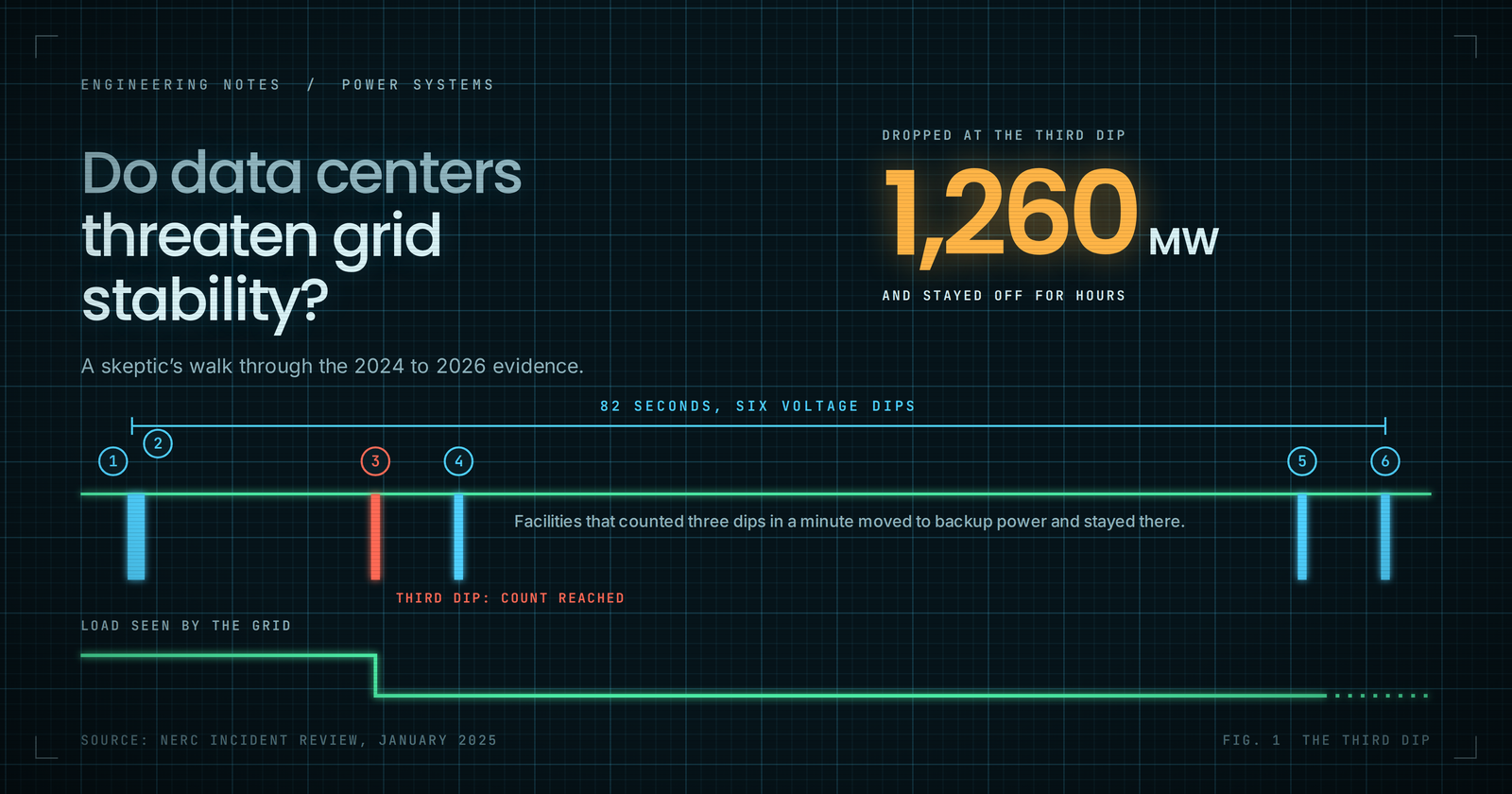
We started out doubting that data centers were a grid problem at all. Six rounds of checking primary sources later, part of that doubt had survived and part had not. This is the path, with the numbers.
The short answer is yes, and the cause is more specific than the general worry about AI electricity demand. Large data centers have repeatedly taken themselves off the grid during faults that the grid cleared in a few hundredths of a second. In the best documented case, a control setting explains most of the loss, and changing that setting helped. A larger event followed anyway. Both things are true at the same time, and this article is organized around that tension.
We wrote it the way we worked through it. Each round begins with something a reasonable engineer would believe, raises the strongest doubt we could find, checks it against NERC, PJM, ERCOT or a published paper, and keeps only what survives. Most figures come from primary documents that we read directly. A few dates come from trade press reports of NERC actions, and the references mark those.
Round 1: A data center is a large customer, and the grid has always handled large customers
The belief. A data center is a big, steady customer. Utilities connect big customers all the time, so the planning questions are about generation and transmission capacity. The customer itself is not expected to disturb the grid.
The doubt. Planners have traditionally worried about losing generators, and generators have to meet ride-through rules for exactly that reason. Losing a large load is the mirror image of losing a generator, because for a moment there is more generation than demand. Does that ever happen at a scale that matters?
The evidence. On the evening of July 10, 2024, a lightning arrestor failed on a 230 kV transmission line in the Eastern Interconnection. NERC's incident review describes about 1,500 MW of load disappearing from the same local area at the same time, all of it data center load, in an area with a high concentration of data centers. None of it was disconnected by utility equipment. The data centers' own protection and controls did it. System frequency rose to 60.047 Hz and settled back to 60.0 Hz in about four minutes. Voltage rose to 1.07 per unit, and operators removed shunt capacitor banks in the local area to bring it back down.
What survives. A skeptic is entitled to say the grid shrugged it off, and NERC agrees that frequency and voltage did not reach levels of concern in that event. What survives is narrower. NERC wrote that the operators did not anticipate a simultaneous load loss of that size, and that grids have historically been planned for large generation losses and not for large load losses. So the event was real, its severity was low, and NERC's concern was that the same kind of loss could grow as data center load grows.
Round 2: A fault that clears in milliseconds should not remove a gigawatt
The belief. Utility protection cleared the fault properly, and a facility with a UPS exists to ride through short voltage dips. So the facility should have ridden through.
The doubt. If a UPS works as designed, moving to battery during a dip is the correct response. So why did the load stay off the grid for hours?
The investigation. The incident review gives the sequence in detail. The failed arrestor produced a permanent fault that eventually locked out the line, and the line's auto-reclosing control was set for three reclose attempts, staggered at each end. The result was six separate voltage depressions within 82 seconds, each lasting between 42 and 66 milliseconds, with voltage between 0.25 and 0.40 per unit in the affected area.
Data centers ride through grid dips with UPS systems, and the review describes how the designs respond differently. With a static battery UPS the load moves to the battery during the dip and returns to the grid once voltage recovers, so the grid sees a short loss of load. With a rotary UPS built around a flywheel and a diesel engine, the load moves to the generator and typically has to be transferred back manually, so the grid sees a loss of load that does not come back quickly.
The review also found a third scheme, and it explains the event. Some facilities count voltage disturbances. If a set number of disturbances occurs within a set time, the facility transfers its load to backup power and stays there until someone reconnects it manually. NERC reports that the typical setting is three disturbances in one minute.
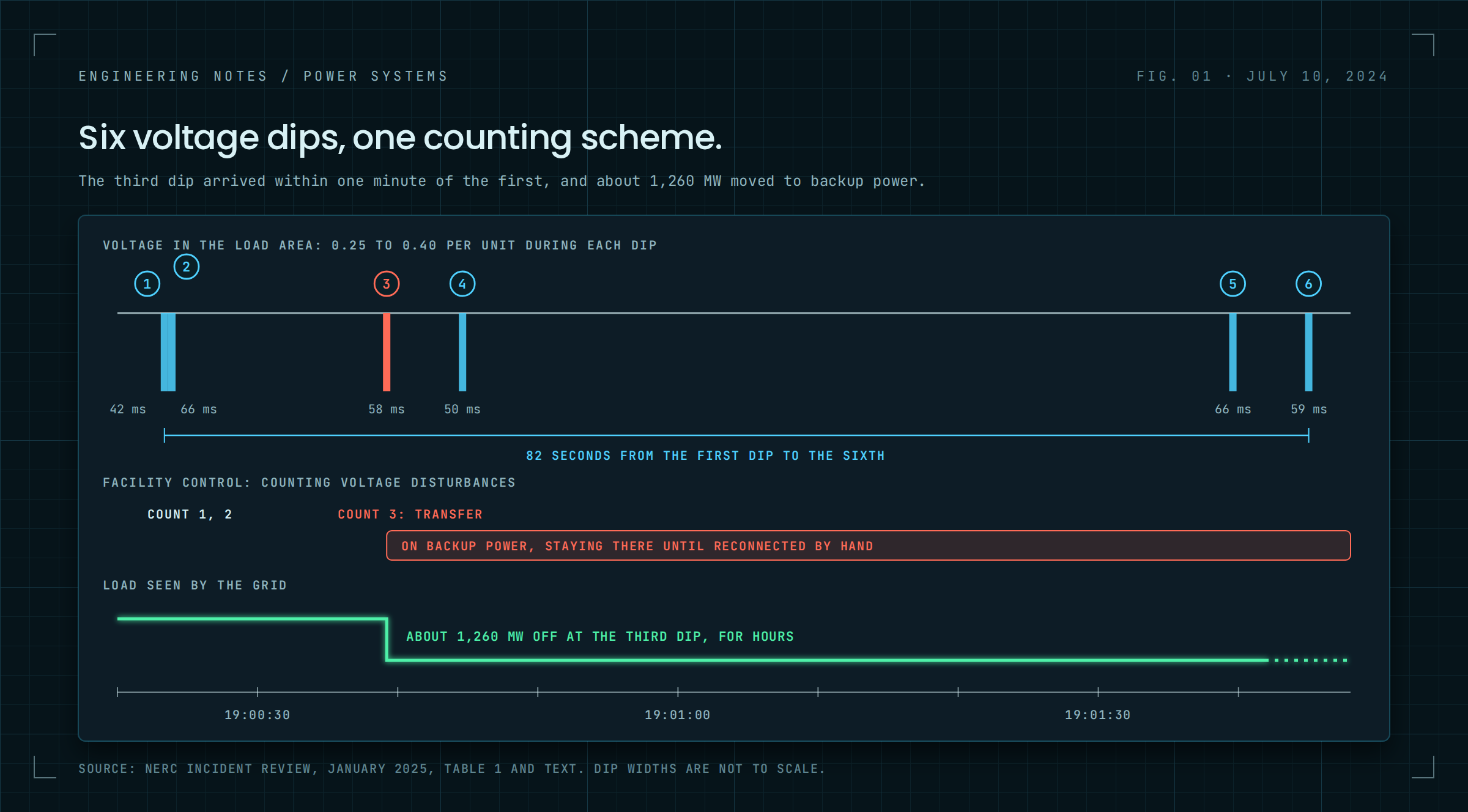
Figure: NERC's timing table for July 10, 2024. The third dip came within one minute of the first, the typical trigger for a disturbance-counting scheme.
About 1,260 MW of load dropped off the grid with the third voltage depression and did not return for hours. NERC attributed most of the load loss to the interaction between the line's auto-reclosing sequence and the facilities' disturbance-counting scheme.
What survives. Both sides were doing something sensible. The utility retried the line to restore service, and the data centers counted disturbances to protect their equipment from repeated dips. Put together, they turned a normal fault into a gigawatt-scale event. NERC's own list of lessons asks transmission operators to consider voltage-sensitive load loss when configuring automatic reclosing, which shows where the interaction sat. The mechanism is a control setting meeting a reclosing sequence, and that is more specific, and easier to change, than a general worry about AI power demand.
Round 3: One event could be a coincidence, and cryptocurrency miners are not AI data centers
The belief. A single incident in one county is an anomaly. The Texas events involve cryptocurrency miners, which tell us nothing about AI facilities.
The evidence on recurrence. NERC's 2026 State of Reliability report lists five more Eastern Interconnection events in 2025: 1,800 MW in February, a second event of 428 MW the same month, 227 MW in March, 540 MW in May and 1,300 MW in June. In ERCOT, nine events in 2025 involved at least 100 MW of customer-initiated load reduction from computational load facilities. NERC's January 2026 review of Texas examined 26 events with indirect load loss above 100 MW at cryptocurrency mining facilities between January 2023 and September 2025, with reductions from about 17 percent to 95 percent of the pre-disturbance consumption.
The second doubt. NERC's review supports the skeptic on the second point. Its review notes that cryptocurrency mining facilities typically have no UPS systems or backup generators, so their ride-through behavior differs from cloud and AI data centers. The Texas events are therefore evidence about a different design. What they give us is a set of mechanisms worth checking in other facilities. That step is our judgment, because NERC's report is specific to mining sites.
The first mechanism is simple arithmetic. Mining facilities rely on a large number of constant-power electronic power supplies, which keep drawing the same power when voltage falls. Power is voltage times current, so current has to rise as voltage drops: I = P / V. At 0.8 per unit voltage the current has to rise by a factor of 1.25, which is the example NERC gives. NERC also reports facilities that tripped their main breakers on overcurrent protection during a voltage depression of only 50 milliseconds. In one of its measured events, a sag slightly below 0.7 per unit for more than 20 milliseconds came with current of about 150 percent of the pre-fault level, close to the 143 percent that an ideal constant-power load would draw at 0.7.
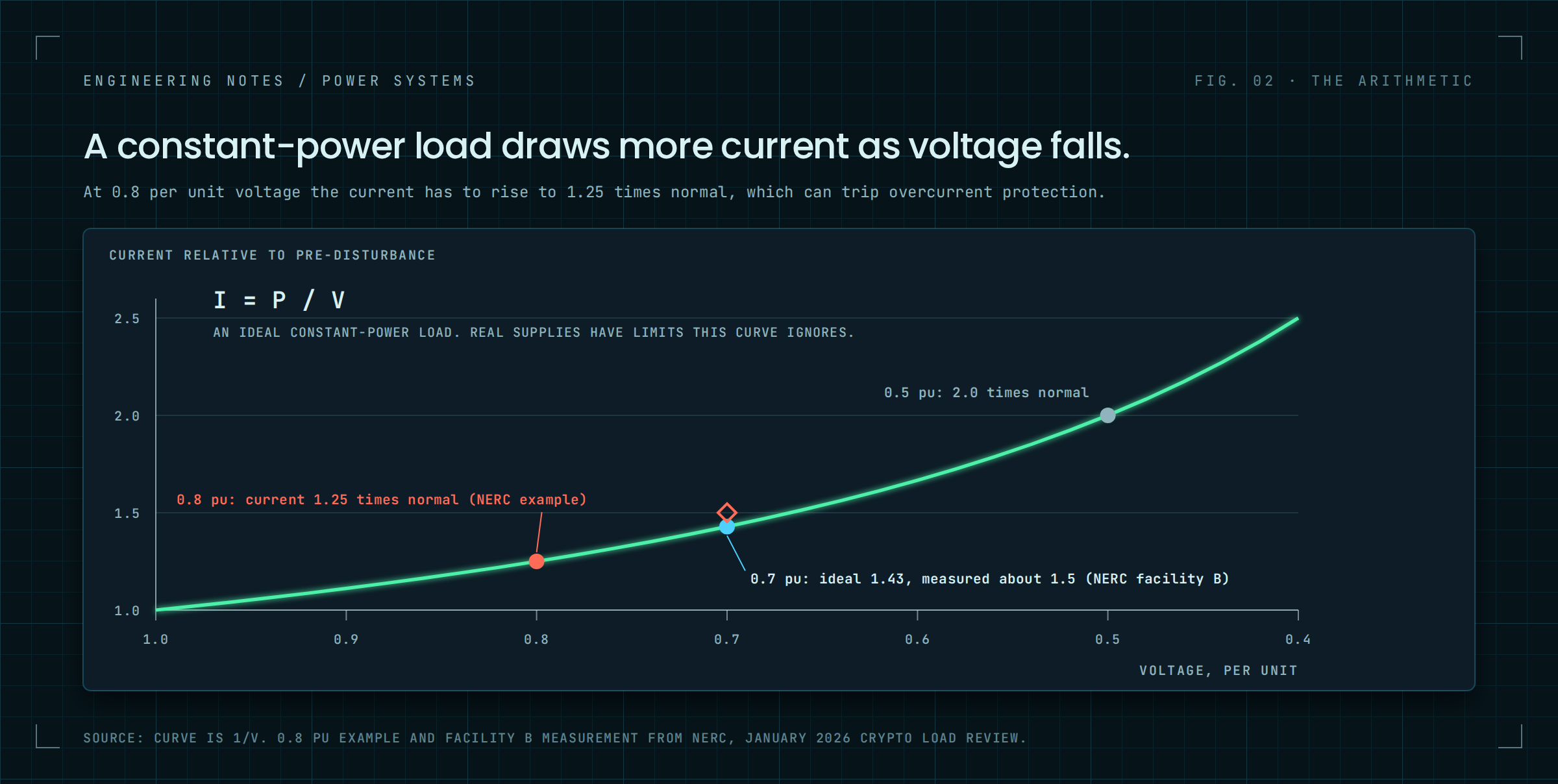
Figure: For an ideal constant-power load, current is power divided by voltage. NERC's 0.8 per unit example and one measured facility are marked.
The second mechanism sits in the cooling plant. NERC found that much of the cooling load in these facilities runs on variable frequency drives with their own low-voltage protection. In one case the undervoltage trip setting was as high as 0.96 per unit, so a 50 millisecond dip from a normally cleared fault took the cooling equipment offline, and once cooling is lost the facility can overheat and shut down completely. NERC recommends reviewing manufacturer default undervoltage settings on those drives and providing UPS support for control circuits and drives, and it notes that ERCOT planned to introduce ride-through requirements for cooling load.
What survives. The events recur, and they are not confined to one county or one kind of facility. Mining sites are a different design from AI data centers, and the lesson to carry over is narrow: the protection and controls around the servers, especially cooling drives and overcurrent protection, can decide what the grid sees.
Round 4: If the cause is a setting, the fix should be a setting
The belief. A counting scheme is a configuration choice. Change the count or the window, and the problem should go away.
The evidence. NERC's September 2026 paper reports that some large data centers worked with grid operators and adjusted the schemes that decide when a facility transfers to backup power. They lengthened the time a voltage dip must last to be counted, and they changed the number of dips in a period that triggers disconnection. The transmission entity also applied those requirements to all newly connected facilities. On April 18, 2026, a fault occurred in the same vicinity and with similar characteristics to the July 2024 event. It produced 500 MW of sustained data center load loss, compared with the 1,500 MW of load loss in July 2024, a reduction of two thirds.
The doubt that remains. Two faults are not a controlled experiment, and NERC is careful with its wording: the improved performance may be attributable to the changes. It also describes the result as showing the technical feasibility of computational load ride-through.
What survives. A settings change goes together with a smaller loss in at least one comparable pair of events, and the grid operator found a way to make the new settings a connection requirement. That is the strongest evidence in this article that the problem can be managed.
Round 5: If the fix worked, the next event should have been smaller
The belief. If a settings change cut the sustained loss by two thirds, the next large fault should remove less load than the last one.
The evidence. On July 22, 2026, at 7:56 a.m., a fault on a 230 kV line in Dominion's zone in Northern Virginia was followed by about 3,800 MW of load transferring to backup generation, according to PJM's operating committee presentation. PJM called it the largest load transfer it has experienced, noting similar events on July 10, 2024 and February 17, 2025. The fault cleared properly, and there were no relay misoperations or stuck breakers. Frequency reached 60.092 Hz. PJM's slides also record something the earlier rounds did not cover: the load transfer caused high voltage conditions, and those conditions triggered the transfer of additional load to backup generation. The slides say the load transfer is likely due to voltage ride-through performance. The same deck includes Dominion's preliminary findings, which list an initial load loss of 2,970 MW and a secondary load loss of 1,099 MW 67 seconds later.
Our reading is that Rounds 2 to 4 were about low voltage during the fault, and this event adds a second path, in which the voltage rise after the first load left pushed more load over the edge.
What the skeptic can still say. The grid held. According to PJM's summary of the event, the grid did not experience significant reliability impacts, although it did see a high imbalance between generation and load and large swings in voltage and frequency. PJM's balancing excursion recovered within nine minutes, against a 30 minute requirement. NERC says the same of the earlier incidents: they did not create near-term or long-term issues for the system.
What survives. The event was about two and a half times the size of the 2024 event. NERC read it as a sign that the risk is increasing and not abating, and noted that the specifics were still being analyzed as of September 2026. The fix in Round 4 shows that ride-through is feasible, and NERC says its first standards cover foundational activities such as commissioning, communications and modeling, with ride-through performance requirements to be considered later.
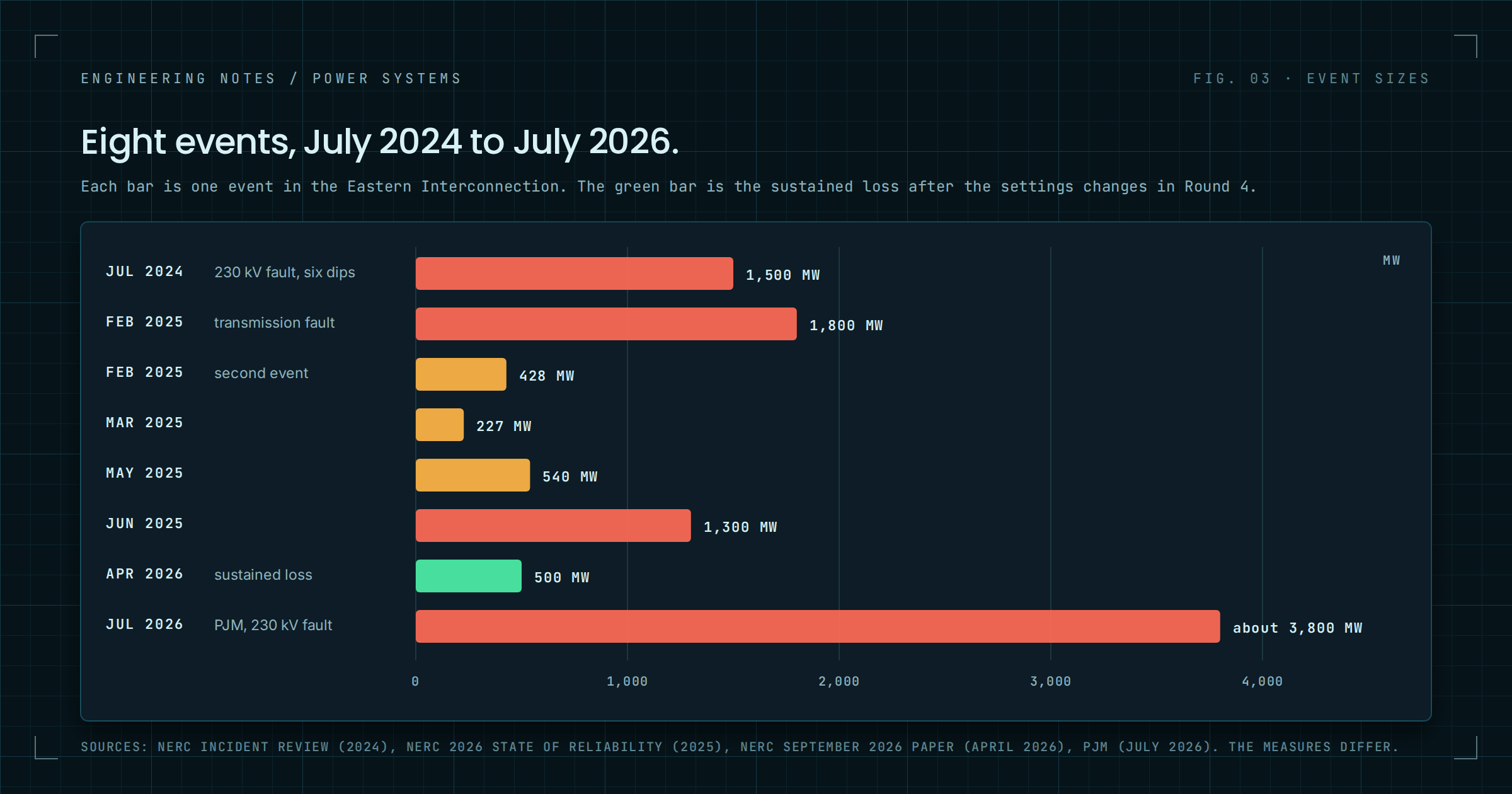
Figure: Documented events from July 2024 to July 2026. The measures differ between sources, so the bars show scale and not a like-for-like series.
Round 6: AI training might behave differently from other data center load
The belief. Whatever the AI boom does to demand, a data center is still a data center.
The doubt. Training jobs run in lockstep. Tens of thousands of GPUs do the same kind of work at the same moment and then stop to exchange results. If the load swings with that rhythm, a training cluster could behave very differently from a hosting facility.
The evidence. A 2025 paper by engineers at Microsoft, OpenAI and NVIDIA lays this out with production data. Each training iteration has a compute-heavy phase and a communication-heavy phase, and power in the communication phase can fall close to idle while the compute phase draws close to the GPU's thermal design power. Because the nodes in a job are co-located and synchronized, the swings add up at rack, data center and grid levels. The authors say that at scale the swings can amount to tens or hundreds of megawatts, at frequencies that, if poorly aligned with the resonant characteristics of grid components such as turbine generators or long transmission lines, can risk grid instability and mechanical failure. Depending on the job, the swing can repeat from about once per second to once every tens of seconds.
The doubt that remains. The same paper cites a 2019 NERC study finding that most of the dominant oscillation modes of the interconnections are highly damped, though damping varies with system topology and configuration. So the risk depends on whether a facility's swing frequency lines up with a lightly damped mode. The authors treat this as a risk to manage. In the documents we read, none ties a specific grid event to training-load oscillation, and the evidence for tripping events in Rounds 1 to 5 is much stronger than the evidence for harm from oscillation. NERC's May 2026 guideline says AI data centers can introduce forced oscillations when their load cycles at 0.1 to 2 Hz, and the guideline and NERC's Level 3 alert both ask planners to account for load behavior during oscillations. NERC's Level 3 alert notes that disturbance models can include the computational load's behavior during power oscillations.
The paper compares three ways to reduce the swings: software changes that smooth power, GPU firmware features that enforce ramp limits and power floors, and rack-level energy storage. It gives one example of the difficulty. If a utility allowed only a 10 MW dynamic range on a 100 MW job, that would be 10 percent, which the authors say GPU power smoothing could not meet at the time of writing.
What survives. Oscillation is a separate problem from tripping, and it has separate fixes. We treat it as a credible risk with limited public event evidence, which is a smaller claim than the tripping events support.
Where the rules stand as of November 12, 2026
- FERC, July 16, 2026. FERC directed NERC to complete registration criteria and the foundational reliability standards for computational loads by the end of 2026, as NERC's September paper describes it.
- NERC Level 3 alert, May 4, 2026. The alert lists seven essential actions on modeling, studies, instrumentation, commissioning, operations, protection and control. It asks planners to collect modeling data, use the PERC1 model or one with equivalent capabilities as a base, model the IT load separately from the non-IT load, and represent cooling drives. The alert states that it creates no mandatory obligation and carries no penalties for not implementing the actions.
- NERC Board, October 26, 2026. The Board adopted the foundational computational load standards, which passed final ballot in mid-October, according to a trade report. A second trade report says the package covers interconnection studies and modeling, operational data and communications, and protection coordination and disturbance monitoring. NERC plans to file the standards with FERC.
- ERCOT, NOGRR282. The Public Utility Commission of Texas approved the rule on July 9, 2026, and it took effect on August 1, 2026. It sets frequency and voltage ride-through requirements for large computational loads. It also says a load shall not use a trip or transfer scheme that disconnects it solely because of a number of voltage sags or swells in a period if it must ride through each one, and where such a scheme cannot be avoided because of equipment limits the load must stay connected through at least six sags or swells within 90 seconds.
- PJM. After July 22, PJM said it is evaluating changes to its interconnection reliability requirements for computational loads, including ride-through.
What the evidence does not show
- No blackout is documented. NERC says the recent load reduction incidents created no near-term or long-term issues for the system, and PJM reports no significant reliability impacts from July 22.
- Mining sites are a different design. NERC notes that they typically lack UPS systems and backup generators, so the Texas findings should not be read as AI data center behavior. NERC's draft white paper also says Northern Virginia's data center load is primarily conventional data centers and not AI-focused computing campuses.
- The cause of the July 2026 event was still being analyzed in NERC's September paper.
- The April 2026 improvement is a probable effect of the settings changes. NERC words it as a possibility.
- Training-load oscillation is a risk and not a documented event in the sources we read.
Seven questions to ask about any large data center connection
These come from reading the sources side by side. They are our reading and not a checklist from NERC.
- How does the facility's transfer logic count voltage disturbances, over what time window, and what resets it after a transfer?
- Has that counting logic been compared with the auto-reclosing sequence on the lines that serve the site?
- What does the facility do when voltage rises after other loads have dropped away?
- Which loads sit outside the UPS, and what undervoltage settings do their drives and control circuits use?
- In what steps, and at what ramp rate, does the load come back after a transfer?
- Is there a validated dynamic model of the facility, and a fault recorder that captures its real response during disturbances?
- For training clusters, what is the peak-to-trough power swing, and how often does it repeat?
The six rounds at a glance
| Round | The belief | What the evidence showed | What survived |
|---|---|---|---|
| 1 | A data center is a steady customer the grid can plan around | About 1,500 MW left in seconds in July 2024, and frequency peaked at 60.047 Hz | The severity was low, and the possibility of a larger loss was real |
| 2 | A fault cleared in milliseconds cannot remove a gigawatt | A disturbance-counting scheme moved about 1,260 MW to backup power at the third dip | The cause is a control setting meeting a reclosing sequence |
| 3 | One event, and mining is not AI | Five more Eastern events in 2025 and 26 Texas mining events | A few mechanisms are worth checking in other facilities |
| 4 | A setting change should fix it | 500 MW of sustained loss in April 2026 against 1,500 MW in 2024 | The problem can be managed in at least one comparison |
| 5 | The next event should be smaller | About 3,800 MW transferred on July 22, 2026 | The risk has grown, and the analysis is still open |
| 6 | AI training is just more load | Synchronized swings of tens to hundreds of MW at scale, per a 2025 paper | A credible risk with limited public event evidence |
Frequently asked questions
How much data center load has dropped off the grid during faults?
NERC documents about 1,500 MW in July 2024 and five Eastern Interconnection events in 2025 of 1,800, 428, 227, 540 and 1,300 MW. PJM reports that about 3,800 MW transferred to backup generation on July 22, 2026, the largest load transfer it has experienced.
Why do data centers disconnect from the grid during a fault that clears normally?
Their protection and controls react to the voltage dip. In the July 2024 event, NERC found that facilities counting voltage disturbances typically moved their load to backup power after three disturbances in one minute and stayed there until reconnected by hand, which interacted with the line's auto-reclosing sequence.
Have these events caused blackouts?
None of the documents we reviewed report one. NERC says the recent load reduction incidents created no near-term or long-term issues for the system, and PJM reports no significant reliability impacts from July 22, while noting a high imbalance and large swings in voltage and frequency.
What is ERCOT's NOGRR282?
It is an ERCOT rule that sets frequency and voltage ride-through requirements for large computational loads, and it bars trip or transfer schemes that act solely on a count of voltage sags where the load must ride through each one. The Public Utility Commission of Texas approved it on July 9, 2026, and it took effect on August 1, 2026.
Is NERC's Level 3 alert on computational loads mandatory?
No. The alert states that it is not a Reliability Standard, creates no mandatory obligation and carries no penalties for not implementing the essential actions. Registered entities must still acknowledge it and report their status.
References
- NERC, Incident Review: Considering Simultaneous Voltage-Sensitive Load Reductions (January 2025)
- NERC, Incident Review: Voltage-Sensitive Crypto Load Reductions (January 9, 2026)
- NERC, 2026 State of Reliability, Overview
- NERC, Reliability Insights: Large Computational Load Risks Due to Voltage Sensitivity (September 2026)
- NERC, Level 3 Essential Action Alert: Computational Load Modeling, Studies, Instrumentation, Commissioning, Operations, Protection, and Control (May 4, 2026)
- PJM, Dominion July Loss of Load Event, Operating Committee presentation (August 6, 2026)
- PJM Inside Lines, PJM, Dominion Review Large Load Transfer Event (August 11, 2026)
- ERCOT, NOGRR282 issue page
- NERC, Computational Loads Standards Pass Final Ballot, Advance to Board Adoption (October 15, 2026)
- American Public Power Association, Board of Trustees for NERC Adopts Foundational Computational Load Reliability Standards (October 27, 2026), trade report
- Utility Dive, Reliability standards for AI data centers, crypto miners move closer to adoption (October 2026), trade report
- Choukse et al., Power Stabilization for AI Training Datacenters, arXiv:2508.14318 (2025)
- NERC, Reliability Guideline: Risk Mitigation for Emerging Large Loads (May 2026)
- NERC LLWG, Large Load Disturbance Performance: Impact Analysis and Ride-Through Recommendations, draft white paper (2026), a draft for comment
Originally published at tech4bizsolutions.com/insights/data-center-grid-stability-evidence.
Comments
Join the discussionNo comments yet. Be the first to comment.


